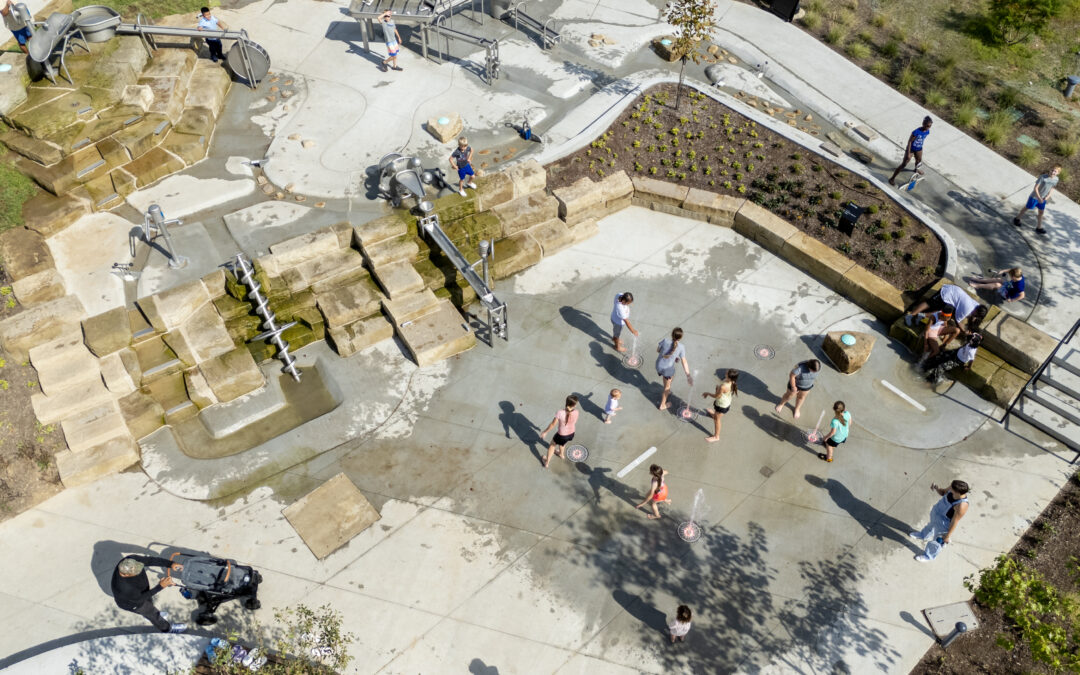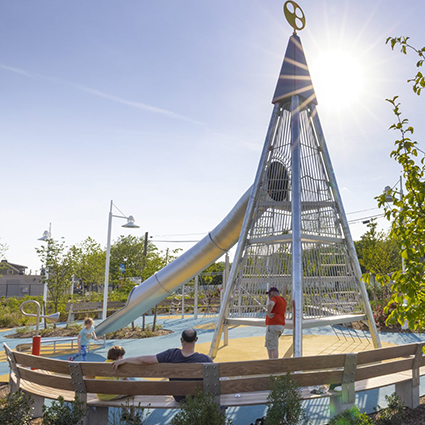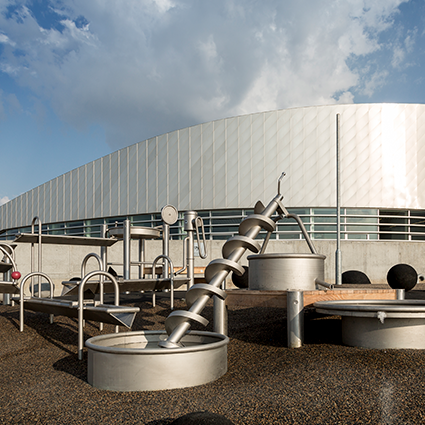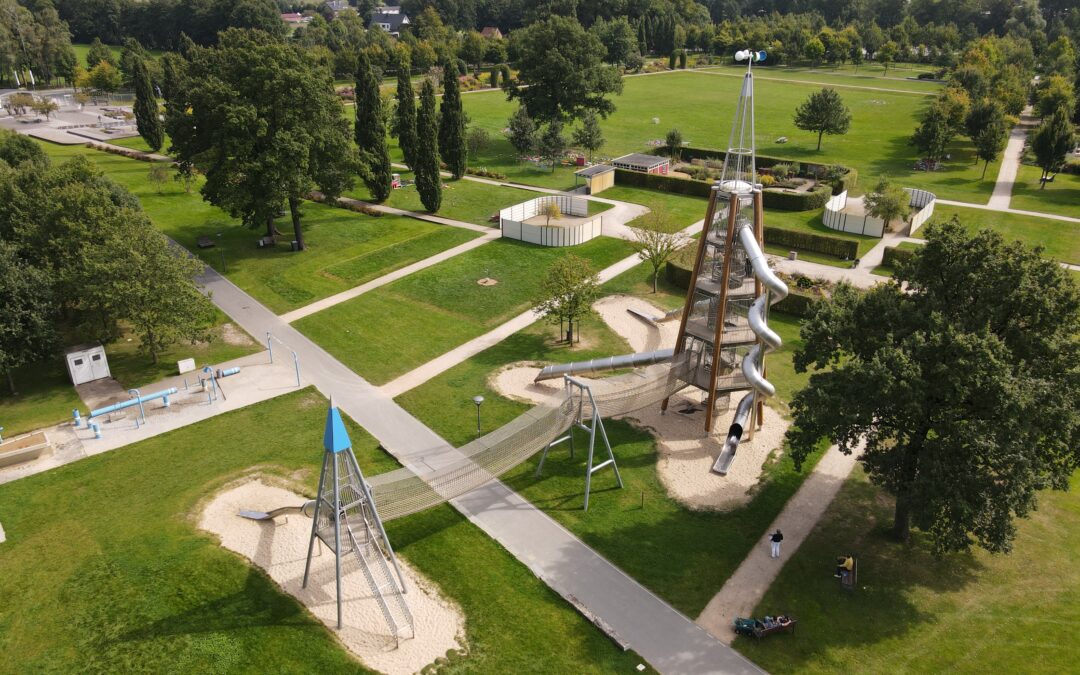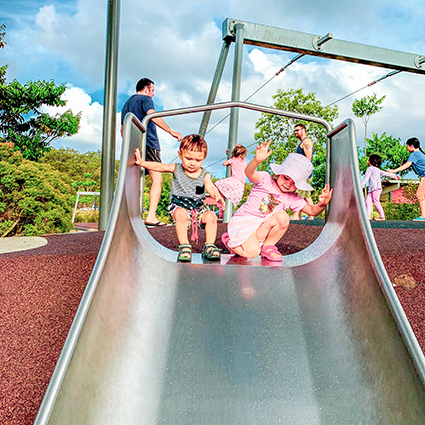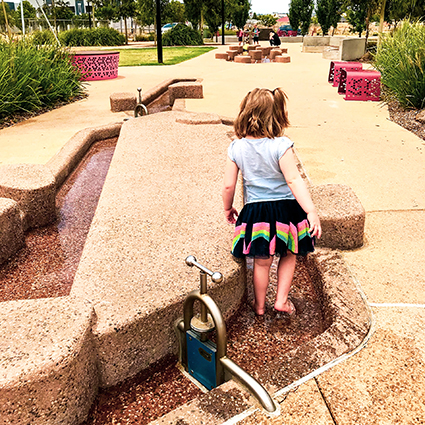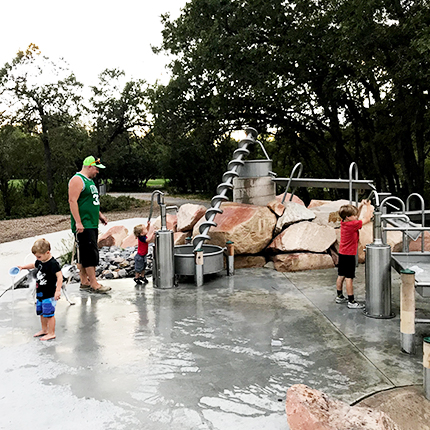
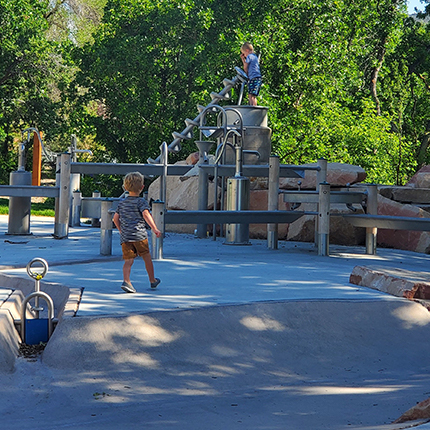


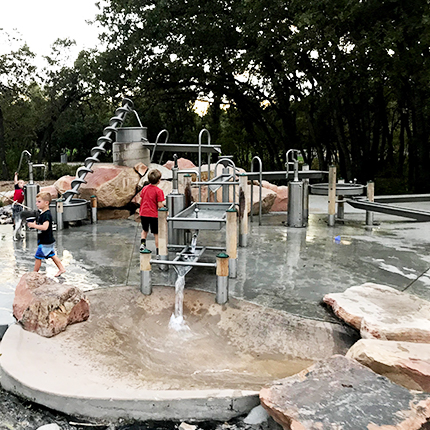
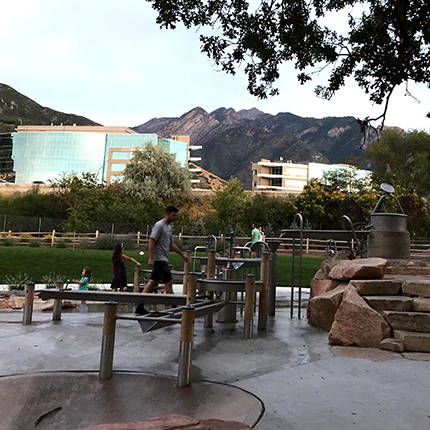
A current trend in water playgrounds is to design outdoor spaces as active water play landscapes: children pump water, direct it through channels, dam it up with flaps and thus experience how the flow direction and water volume change. The water play area in Knudsen Park in Holladay, Utah, is a very good example of this type of interconnected water play in public spaces.
The facility is based on robust stainless steel water feature elements, as supplied by Kaiser & Kühne through its North American partner Goric Marketing Group USA.
The location – City Park in historic Knudsen’s Corner
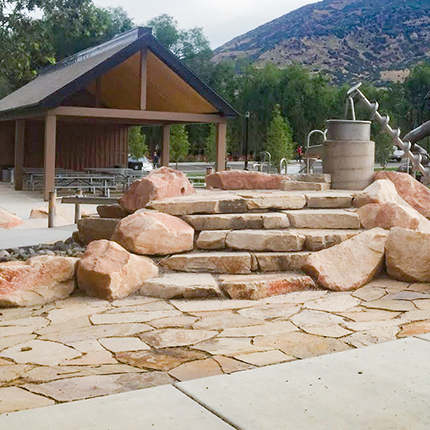
Knudsen Park is located in Holladay, a suburb of Salt Lake City on the edge of the Wasatch Mountains. The site is part of the historic Knudsen’s Corner area and was formerly used for agriculture and commercial purposes. Today, in addition to the water play area, the park offers a playground, a hammock garden, lawns, a pavilion, an outdoor classroom and walking trails – a versatile meeting place for a town with a population of around 32,000.
The City of Holladay presents the park on its website as an important part of the municipal open space provision and provides information about its facilities, opening hours and location. More information can be found on the City of Holladay’s Knudsen Park page.
The task – more than just a classic splash pad
Instead of a simple splash pad with jets and fountains, the city wanted a water play area where children could actively:
- Set water in motion,
- Control paths and branches yourself,
- try out different flow rates,
- and experience scientific phenomena in a playful way.
The facility should also offer a pleasant environment for parents and grandparents, be easily visible and blend in with the design of the rest of the park.
Our solution – stainless steel water feature with channels, weirs and screw
The water play area covers around 4,000 square feet (approx. 370 m²) and is slightly terraced in the park. A system of stainless steel channels, basins and storage elements is installed above a concrete surface, distributing the water to different levels.
Characteristic elements are:
- Hand pumps and cranks
Children activate the water flow themselves – nothing happens automatically, but through their own movement. - Channels, weirs and flaps
Adjustable gates and dams can be used to change the direction and volume of the water flow. Children decide together where the water should flow. - Archimedes screw
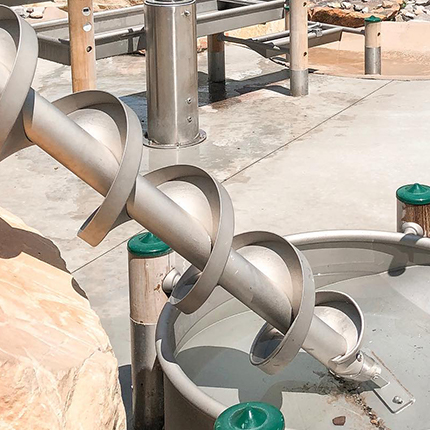
An Archimedes screw visibly transports water upwards and illustrates physical principles such as force transmission and height difference. - Natural materials
Sandstone blocks, gravel and planting anchor the stainless steel elements in a landscape reminiscent of natural streams and irrigation ditches.
The technical components are based on modular systems such as our water play facilities and complementary water play equipment, which are designed for long service life, high usage intensity and good maintenance accessibility.
Learning through play – understanding water in public spaces
At Knudsen Park, great importance was attached to ensuring that children not only ‘splash around’ but also understand how things work. The sequence of pumping, opening, steering, damming and diverting supports this:
- basic scientific experiences (gradient, flow velocity, volume),
- Fine motor skills through turning, pulling and operating the controls,
- social skills, because children have to coordinate with each other in order to use the entire waterway sensibly,
- Attention and perseverance, as many children stay at one station for longer and keep trying out new variations.
Specialist articles such as Goric’s ‘Outdoor Water Laboratories Gaining Ground’ show how this type of networked water play landscape is becoming increasingly important in North America – and cite Knudsen Park as one example.
History of the town and civic engagement
The area has a long history: it was settled in the 19th century by Rasmus Knudsen, who came from the Netherlands, and over the decades served as a mill site, family camp and farm, among other things. Water and irrigation played a central role in this – a motif that is deliberately taken up in today’s water play area.
When a developer wanted to build an office complex on the site, citizens campaigned to preserve it as public green space. With the help of a municipal bond and subsidies (including from the Land and Water Conservation Fund), the city was able to purchase the land and develop it as a park.
Result – impressive water play area that sets an example
Today, the water play area in Knudsen Park is a popular meeting place for families and children in Holladay. The facility demonstrates how hydrologically inspired water play concepts can be implemented in public spaces using high-quality stainless steel elements – embedded in a park design that combines history and the present.
Together with partners such as Goric Marketing Group USA, Kaiser & Kühne is now implementing such projects at several locations. Another example with a strong water focus is our water playground in Gatton Park in Lexington.