
Inclusion
A world where everyone can participate...What does inclusion on a playground mean to us?
Children and young people have always had different physical and mental abilities, depending on their age, physical constitution, and any disabilities they may have. Not all children and young people have always been able to use all play equipment to its fullest extent, but this is precisely what motivates them to try to climb a little higher today or tomorrow than they did yesterday.
Children develop, and playgrounds are the original places where this can happen easily and playfully in a protected atmosphere. This development can take place in many different ways: physically, socially, emotionally, cognitively, alone, and together with others. Playgrounds are places of encounter. In this catalog, we show you the specific developmental opportunities offered by each of our playground equipment items. To do this, we have created a number of icons that give you a quick overview.
Not every child will be able to use every piece of equipment, that has always been the case, but a truly inclusive playground is a place where every child should find something that offers a special personal incentive to play there alone or with other children, to try things out and develop. Ultimately, the appeal of a playground always lies in the personal “thrill” that a child feels, and that is not a question of age, strength, size, or disability. Children are all different, and yet they are all the same.
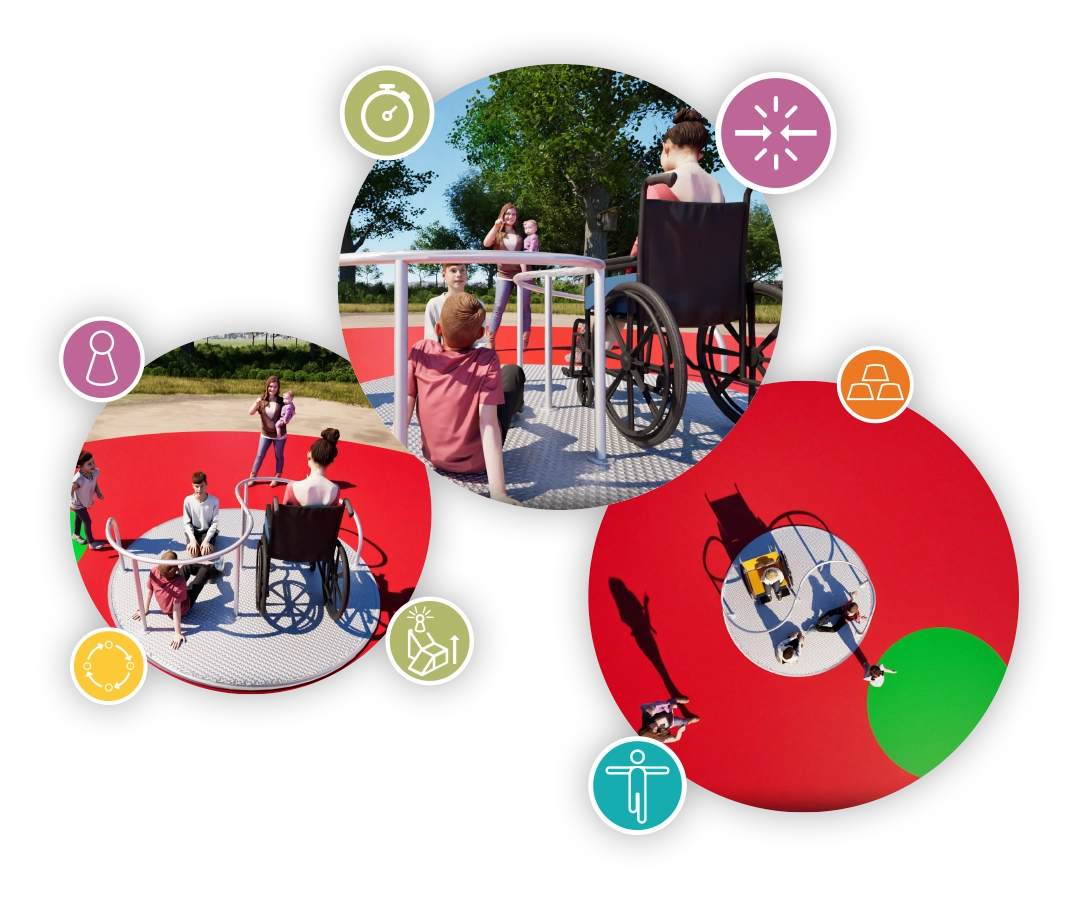
Our symbolism explained briefly

Listening
The sense of hearing is specifically addressed through a variety of activities, such as our sound game, the telephone booth, and other play equipment in the themed play category.

See
Here, the sense of sight and the eyes are deliberately addressed as a theme. The sense of sight is stimulated by special optical stimuli such as our effect lenses, distorting mirrors, or even simple peepholes and portholes. Optical illusions also fulfill these requirements.
feel
The skin is our largest sensory organ. This involves passive sensation, e.g., covering the skin with sand or water, even at different temperatures.

keys
This involves tactile contact, touching and feeling. This sense can be stimulated, for example, by deliberately arranging different materials in varying thicknesses and surface structures.

fine motor skills
Fine motor skills are another aspect of sensory perception and are influenced and addressed by a wide variety of play options, depending on the child’s abilities. Examples include steering wheels, sand lifts, small multi-purpose play walls, and much more.

balance
Balance exercises are designed to specifically target the sense of balance. This can be achieved through balancing exercises with varying degrees of difficulty (different widths, inclines, surfaces, materials, heights, balance beams, ropes, wobbly bridges, ramps), but also through rocking, jumping, swaying, and hopping.

coordination
The interaction of different sensory organs and physical motor skills for a purposeful sequence of movements is understood as coordination. Climbing, horizontal bars at different heights, elements for hanging, but also stairs, ramps, ladders, stair-like ascents, and jumping and spinning games influence the development of coordination.

speed
The experience of movement involving speed, acceleration, and deceleration is usually generated by cable cars, slides, carousels, and swings, but also by fireman’s poles, for example.

high altitude experience
An experience of height specifically illustrates the perception of different heights, e.g., looking down on something from above, well beyond eye level. Climbing equipment, towers, viewing platforms, and swings particularly appeal to this perception.

Communication
Communication refers primarily to areas with a high quality of stay that specifically promote communication between users and invite them to linger. This can be achieved, for example, by providing seating, resting, and reclining options or seating and table combinations that are arranged in relation to one another.

self-perception
Users should be able to perceive the influence they and their actions have on their environment, as is the case with physical experiences where, for example, different quantities can be formed or grasped when playing with sand and water, and comparisons of size and quantity can be made. This can be achieved by increasing skills and abilities through a variety of activities involving similar movements and different levels of risk.

group games
Group play should encourage, promote, and support joint activities. Suggestions for joint role-playing games (playhouse combination) or a water and mud play area support this type of interaction, as do climbing frames with space for several children.

Parallel play
When playing in parallel, children do not play directly with each other, but rather side by side, independently of each other. Examples of equipment for this would be a row of monkey bars or a classic sandpit.

individual games
Individual activities, facilitated, encouraged, or supported by play options—that’s what individual games are all about. These are designed specifically for users who need a safe play environment. The aim is to enable and enhance self-awareness, facilitate and encourage experiences, and allow users to feel and develop themselves, their bodies, and their senses. This can be achieved, for example, through all kinds of natural/designed retreats such as playhouses, tunnels, or crawl tubes, but also through games of skill.

opportunity to meet
Encounters can be encouraged through playground design or, for example, bridges, crawl tunnels, or double zip lines.

drama play
Drama or role-playing is an imaginative game in which children reenact situations they have experienced or observed. The children slip into a different role and pretend. Drama play is further enhanced by appropriate stages, platforms, or balconies.
Functional play
The fixed movements of slides, carousels, and other rides create a predefined and constantly repeating experience for users. One could also say that users know without surprise what is about to happen. This reinforces their understanding of loops.

Exploratory play
The focus here is on learning incentives. Users can playfully acquire knowledge about physical laws (centrifugal force, gravitational pull, or centrifugal force) or technical skills in handling special game elements (Archimedes’ screw).
We build recreational equipment for children and adults.
Open spaces for play and exercise are becoming increasingly scarce in our cities and communities. That is why it is important that play and exercise areas are designed in a timely and appealing manner so that they can be preserved in the long term. They should be family-friendly, meet the needs of users, and, of course, be safe. Kaiser & Kühne is your partner for high-quality, safe, and durable recreational equipment. Kaiser & Kühne – PREMIUM PLAYGROUNDS
